The Boiler Produces Steam — But These Accessories Ensure It Reaches Its Destination Safely
Many facility owners and engineers spend significant time and money selecting the right steam boiler and high-quality piping, yet overlook steam line accessories or choose them without proper engineering consideration.
The result is often a steam network plagued by water hammer, steam leaks, unstable pressure, increased maintenance costs, and unexpected downtime.
The reality is that steam line accessories are not optional add-ons. They are essential components that ensure steam is delivered at the correct pressure, quality, and flow rate throughout the system.
Flexible Expansion Joints: Protecting the System from Movement and Vibration
Steam pipelines continuously expand and contract due to temperature fluctuations.
For example, a 10-meter steel pipe can expand by approximately 12 mm when its temperature rises from ambient conditions to around 200°C.
If this thermal expansion is not properly accommodated, excessive stress is transferred to piping, valves, supports, and equipment connections, leading to premature failures and steam leaks.
Flexible expansion joints are typically installed in two critical locations:
- Between the steam boiler and the steam distribution network.
- At directional changes within the steam line.
These components absorb thermal movement and vibration while protecting the overall system from mechanical stress.
Selecting the correct expansion joint depends on:
- Pipe diameter
- Steam pressure
- Operating temperature
- Expected movement range
An undersized expansion joint may fail prematurely, while an oversized one can unnecessarily increase project costs.
Pressure Reducing Stations: The Heart of Steam Pressure Control
Steam often leaves the boiler at pressures ranging from 8 to 12 bar or higher.
However, many industrial processes operate efficiently at much lower pressures, typically between 2 and 4 bar.
This is where pressure reducing stations become essential.
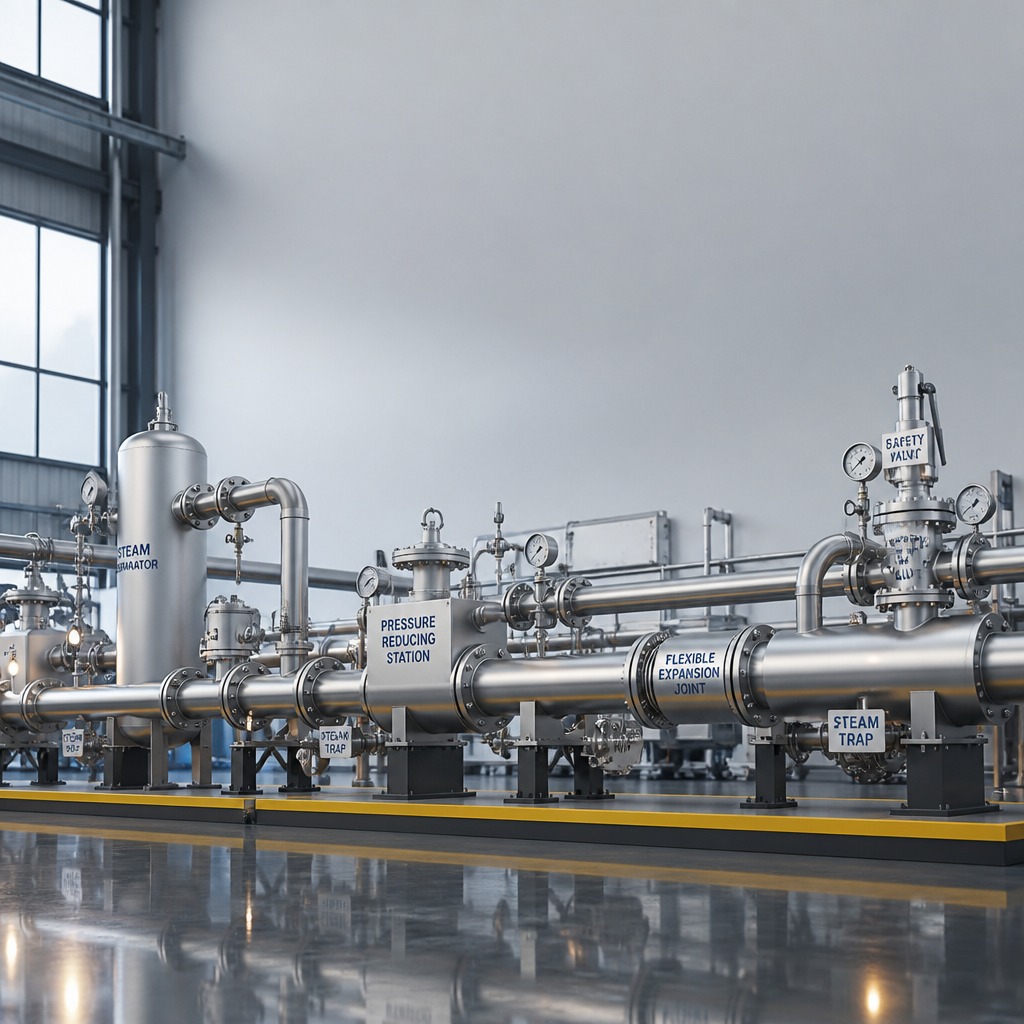
A complete pressure reducing station usually includes:
- Isolation valve
- Y-Strainer
- Pressure reducing valve
- Pressure gauge upstream
- Pressure gauge downstream
- Safety relief valve
Together, these components convert high-pressure steam into a stable, controlled, and safe supply suitable for process requirements.
A poorly selected pressure reducing valve can result in fluctuating steam pressure, directly affecting process consistency and product quality.
Pipe Supports: The Foundation of a Reliable Steam Network
Pipe supports do far more than simply hold pipes in place.
Properly designed supports perform three critical functions:
- Carry the weight of the pipe, insulation, steam, and condensate.
- Allow thermal movement without restricting expansion.
- Prevent vibration from transferring into building structures.
The three most common support types are:
Fixed Supports
Used to anchor the piping system and control thermal expansion direction.
Sliding Supports
Allow longitudinal movement of the pipe during expansion and contraction cycles.
Spring Supports
Used in vertical piping systems and locations where load variations occur between operating and shutdown conditions.
Incorrect support spacing can lead to pipe sagging, condensate accumulation, and increased risk of water hammer.
Steam Separators: Ensuring Dry Steam Delivery
Steam generated by boilers often contains suspended water droplets known as wet steam.
These droplets reduce heat transfer efficiency and can damage downstream equipment.
A Steam Separator removes moisture from the steam before it reaches critical process equipment.
Steam separators operate using centrifugal force.
As steam enters the separator, water droplets are forced toward the outer wall and collected at the bottom, where they are discharged through a steam trap.
Meanwhile, dry steam exits through the outlet and continues to the process.
Steam separators are commonly installed:
- Immediately downstream of the boiler.
- Before heat exchangers.
- Before autoclaves and sterilizers.
- After pressure reducing stations.
Steam Traps Every 30 Meters: A Fundamental Engineering Rule
Steam traps remove condensate while preventing live steam from escaping into the condensate return system.
A widely accepted engineering practice is to install steam traps every 30 meters on long horizontal steam mains, in addition to process equipment drainage points.
Condensate continuously forms inside steam lines due to unavoidable heat loss, even when pipes are properly insulated.
Without adequate drainage, condensate accumulates and creates water slugs that travel at steam velocity.
These water slugs can strike valves, bends, and equipment with tremendous force, causing water hammer.
Water hammer can result in:
- Pipe damage
- Valve failure
- Equipment breakdown
- Safety hazards
Each steam trap station should also include a condensate collection pocket to improve drainage efficiency and extend trap service life.
Proper Pipe Slope Design: Let Gravity Work for You
Correct pipe slope is one of the most important — yet often overlooked — aspects of steam system design.
Horizontal steam lines should never be perfectly level.
Instead, they should be installed with a controlled slope to promote condensate drainage.
The recommended slope for steam mains is generally between 1% and 2%, equivalent to 1–2 centimeters per meter of pipe length.
Whenever possible, the slope should follow the direction of steam flow.
This allows both steam and condensate to travel together, minimizing condensate accumulation.
Improper pipe slopes often lead to:
- Condensate pooling
- Water hammer incidents
- Reduced efficiency
- Unstable operation
Conclusion
Steam line accessories are not optional engineering extras—they are critical components that determine the efficiency, reliability, and safety of the entire steam system.
Flexible expansion joints protect against thermal stress.
Pressure reducing stations ensure stable operating pressure.
Pipe supports maintain structural integrity.
Steam separators improve steam quality.
Steam traps prevent water hammer and energy losses.
Proper pipe slopes ensure effective condensate drainage.
Together, these components transform a simple steam pipeline into a professionally engineered steam distribution system capable of delivering reliable performance for decades.
At Mecart, we provide complete engineering solutions for steam systems, including steam boilers, steam distribution networks, condensate recovery systems, and all essential steam line accessories.
Contact our engineering team today to design the optimal steam system for your facility.
Website:
https://mecart.io/
Email:
info@mecart.io
Phone:
(+966) 56 243 0498